
Services
Field Automation with Raspberry Pi
A concrete example of the technology we bring to village fields and farms: automating a solar pump, water tank and drip irrigation with a Raspberry Pi.
Sound familiar?
Still driving out just to press a button?
Anyone with a village field knows it: one trip to switch the pump on, another to switch it off. Automation removes the trips, the cost and the sleepless nights.
Problem
You drive to the field every day just to turn the pump on and off.
Solution
Pump and valves switch from your phone with one tap; no more trips or fuel.
Problem
You can’t tell if the tank has overflowed or run dry without going to look.
Solution
A level sensor watches the tank; the pump stops when full, restarts when low and lets you know.
Problem
The well ran dry and the pump burned out running empty.
Solution
Dry-run and current protection stop the pump in time and alert your phone.
Problem
You get up before dawn to go and switch valves.
Solution
Parcel-by-parcel schedules run on their own; irrigation is done while you sleep.
Problem
You don’t know how much water you give; sometimes too much, sometimes too little.
Solution
Soil moisture sensors measure real need, so water and energy are not wasted.
Problem
You’ve heard about grants but dread the paperwork, project and specifications.
Solution
We prepare the file with you from pre-assessment to installation; smart irrigation gets a 70% grant.
Example project
Pump, tank and irrigation automation with Raspberry Pi
A typical village field where a solar pump lifts water from a well into a tank, and the tank feeds drip irrigation. Today the pump is switched by hand, the tank overflows or runs dry, and irrigation times are guesswork. A small Raspberry Pi-based control panel measures and automates the system and lets you manage it from your phone.
- Controller
- Raspberry Pi
- Connectivity
- 4G or LoRaWAN
- Management
- Phone and WhatsApp
- Without internet
- Runs on a local schedule
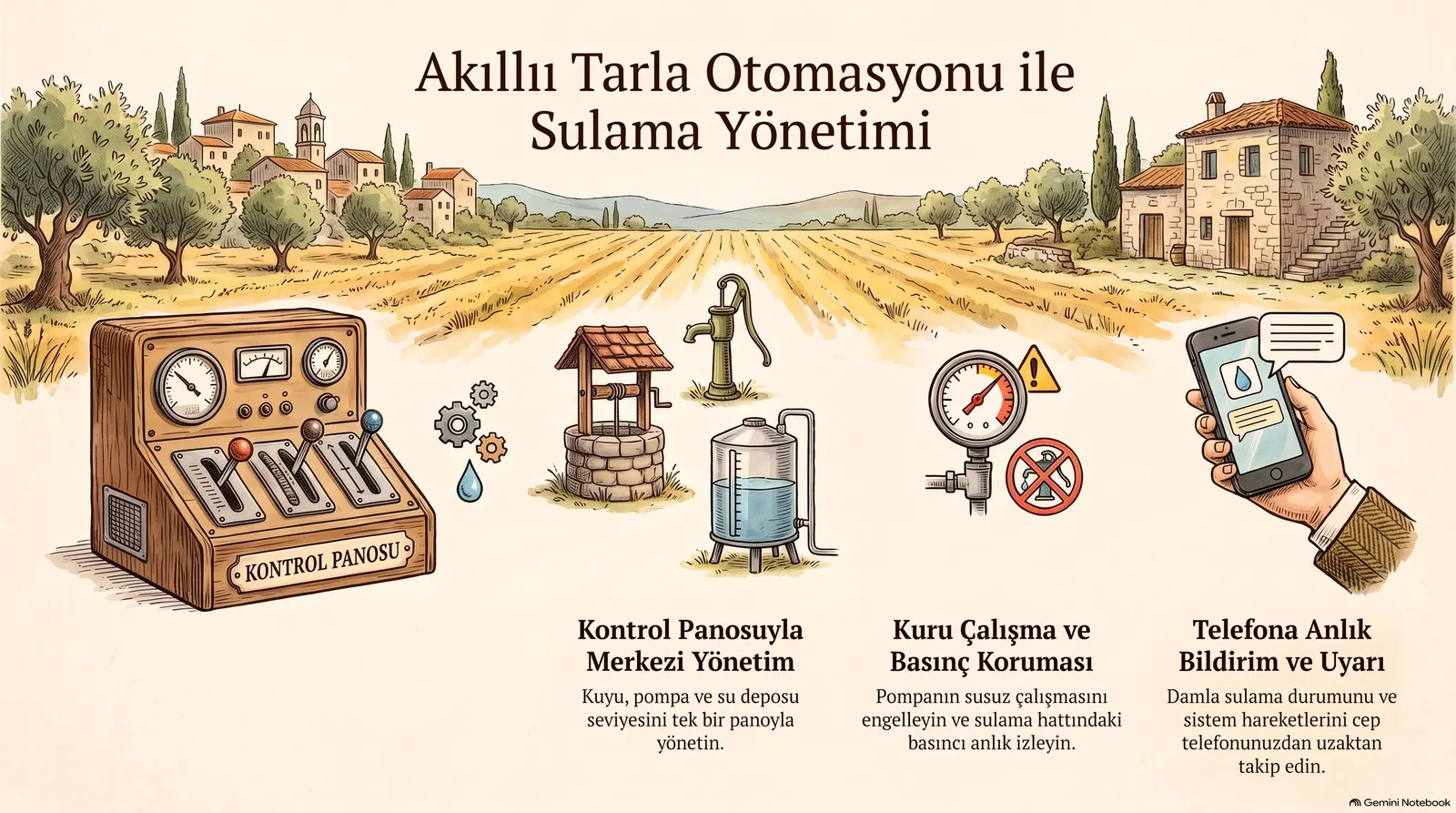
What can it do?
Pump by tank level
The pump stops when the tank is full and restarts below a set level. No more overflowing or empty tanks.
Dry-run protection
When the well runs low or current is abnormal, the pump is stopped safely and an alert goes to your phone.
Irrigation by soil moisture
Multi-depth moisture sensors measure the soil's water need; valves open only when and as much as needed.
Scheduled programmes
Early morning and cool evening irrigation, parcel by parcel; schedules are changed from your phone.
Pressure and flow monitoring
Line pressure and flow are tracked; burst pipes, clogged filters or leaks are caught early.
Energy monitoring
Solar output and pump power are logged; the pump runs when the sun is most productive.
Remote control and alerts
Status screen, manual on/off, and fault, level and moisture alerts on your phone and WhatsApp.
Data logging and AI
Collected data is reported over time; irrigation suggestions come from weather forecasts and past use.
How is it built?
- 01
Measure
A level sensor in the tank, pressure and flow sensors on the line, soil moisture probes in the field and a current sensor on the pump line.
- 02
Control
The Raspberry Pi reads the sensors and drives contactors and solenoid valves through a relay board. High power goes to a protected panel, never directly to the board.
- 03
Connect
A 4G modem in the field or LoRaWAN for remote spots. If the link drops, the local schedule keeps running.
- 04
App
Data goes to the cloud; status, charts, schedules and alerts are managed from your phone.
Why decisions are made on site
We process measurements on the Raspberry Pi before sending them to the cloud. Dry-run, overflow or pressure-drop decisions are made on site within seconds, and protection and schedules keep running even if the internet drops. The cloud stores history, produces reports and generates suggestions.
Example hardware list
- Raspberry Pi controller with an industrial SD card or SSD
- Relay board, contactor, motor protection switch and fuses
- Hydrostatic tank level sensor
- Pressure transmitter and flow meter
- Multi-depth soil moisture and temperature probes
- Current sensor for the pump line
- Solenoid valves
- 4G modem or LoRaWAN gateway
- Battery and charger for uninterrupted power
- IP65 outdoor enclosure
Safety and reliability
- The pump and high-power equipment are driven through contactors and protection devices; a licensed electrician makes the connections.
- Hardware watchdog and safe default state: on a fault the pump switches off.
- If the internet drops, the system keeps running on its local schedule and syncs logs when back online.
- The enclosure is dust and water resistant (IP65) with lightning/surge protection.
Grant-ready smart irrigation setup
Smart irrigation and automation get 70% under the water-saving irrigation grant. What we watch to build the same system to grant rules:
- The designed area must be at least 50 decares; adjoining parcels can be combined.
- Control panel, soil moisture probes, weather station and wireless valve units (LoRaWAN/868 MHz, at least 2 km range, IP67) are specified brand-neutrally.
- CE/TSE-certified control equipment is used within the grant; a custom Raspberry Pi panel serves non-grant projects or adds a monitoring layer.
- For payment all components must be installed and running in the field; the directorate signs the inspection report (Annex 17) with the system running.
- Installation must be a single line on the purchase invoice; if listed separately it is not grant-eligible.
A project for your field
Let's work out on site which automation suits your well, pump, tank and field.
Request a site surveyWe will share new application examples on this page as we add them.